
Veneers for discolored teeth are the one request where two patients get opposite answers. One walks out with a clean, even smile. The other is told to treat the tooth first.
The difference is almost never the ceramic. It is where the colour lives.
This article explains what a veneer can block, what it cannot, and how to tell which case is yours before you book a flight.
A note from Dr. Kim — Many people who land on this page share one quiet worry: what if I damage healthy teeth for nothing? It is the first question I ask myself with every patient.
Blanche began with that question: why harm a natural tooth worth more than any restoration? That is why our signature Blanche no-prep veneers follow one rule — minimal intervention, maximum beauty.
Why veneers for discolored teeth do not simply paint over the colour
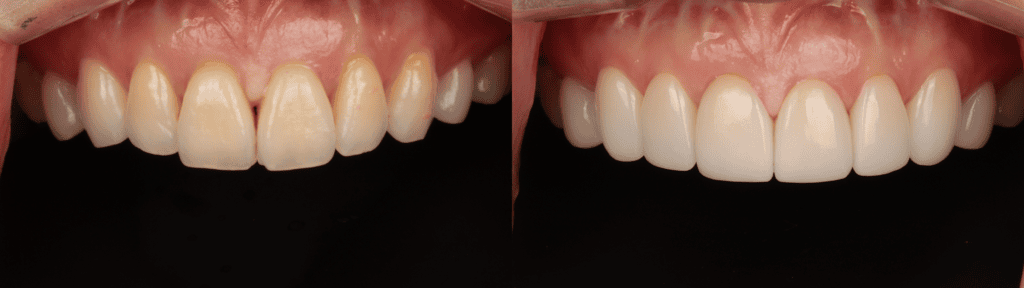
A veneer is thin. On a prepared tooth it is often around half a millimetre, and on a no-prep case it can be thinner still.
Think of a sheet of paper laid over a pencil mark. One sheet lets the mark show. Several sheets, or a thicker card, hide it completely.
Ceramic behaves the same way. Light passes through it, hits whatever is underneath, and comes back out through the veneer.
That is why a dark tooth can still read as dark under a beautiful veneer. You are not looking at the veneer. You are looking at the tooth through it.
Veneers for discolored teeth: four things that block colour
1. Thickness
More ceramic means less light reaching the dark surface underneath. This is the single biggest factor, and it is why masking and minimal preparation pull against each other. Hiding more colour usually means removing a little more enamel.
2. Opacity of the ceramic
Ceramics are made in different translucencies. A highly translucent block looks wonderfully natural on a healthy tooth, and it is the wrong choice over a dark one. A more opaque layer blocks the substrate but can look flat if used carelessly, so good work usually layers both.
3. The cement shade
This one surprises people. The bonding cement sits between the tooth and the veneer, so its shade changes the final result. An opaque or brightened cement can lift a moderately dark tooth without any extra ceramic.
We use the Ivoclar bonding system, which sits at the top of the price range for adhesives. It is chosen for biocompatibility and for colour stability. A cement that yellows over time undoes the masking you paid for, and that matters far more on a dark tooth than on a light one.
4. How dark the tooth actually is
Masking one shade of yellow is routine. Masking a grey, banded or near-black tooth is a different job. As a rough rule, every extra step of darkness needs more thickness, more opacity, or both.
Veneers for discolored teeth: which kind of discolouration do you have?

Sort yourself into one of these before assuming veneers are the answer.
| Type | What it looks like | Veneer outcome | Better first step |
|---|---|---|---|
| Surface staining | Even yellowing from coffee, tea, tobacco | Masks easily | Consider whitening alone |
| Age-related yellowing | Gradual, darker near the gum | Masks well | Whitening, then veneers if shape also matters |
| Single dark tooth after root canal | One grey or brown tooth | Masks, but needs opacity | Internal whitening first where possible |
| Tetracycline banding | Grey or blue-grey horizontal bands | Hardest to mask; needs thickness | Plan preparation and opacity deliberately |
| White spots | Chalky bright patches | Masks well | Try resin infiltration first |
| Enamel hypoplasia | Pitted brown or mottled areas | Masks well | Assess how much enamel remains |
The two rows worth pausing on are tetracycline banding and the single dark tooth.
Tetracycline banding
Here the colour is inside the dentine, laid down while the tooth was forming. Nothing applied to the surface reaches it.
Veneers work on these cases, but rarely as ultra-thin, no-prep ones. Being told that a deeply banded tooth can be covered with a wafer of ceramic and no preparation is a warning sign.
One dark tooth among light ones
This is the hardest match in cosmetic dentistry, because the neighbours are the reference. You cannot hide an error when a perfect comparison sits right beside it.
Where the tooth has had root canal treatment, internal whitening can often lift it several shades first. That reduces how much masking the veneer has to do. Our guide to veneers after root canal treatment covers the structural side of that decision.
Whiten first, then veneer

Patients often assume whitening is pointless if veneers are coming. The opposite is usually true.
Veneers do not respond to whitening gel, and neither does bonding cement. Whatever shade your natural teeth are on the day of bonding is the shade they stay.
So if you plan to whiten at all, do it before. Otherwise the untouched teeth stay dark next to bright new veneers, and the only fix is more veneers.
If you are still deciding between the two treatments, veneers versus whitening sets out which problem each one actually solves. For what the shade codes mean once you are choosing a colour, see our veneers shade guide.
And if your worry is the veneer itself changing colour later, do veneers stain answers that separately.
Not sure where your case fits? Send two photos — front and smiling — on WhatsApp. We will tell you what is possible before you book any flight.
Planning veneers for discolored teeth as a visitor to Seoul
Masking cases reward planning, because the decisions happen before you arrive. Send two photographs in daylight without a flash, one straight on and one at an angle, with your lips retracted if you can. From those we can usually tell whether you are a straightforward masking case or a layered one.
Our prices are the same for international and Korean patients, with no foreigner surcharge. The item list is on our pricing page. For the full one-day programme — technology, pricing and booking — see our One-Day Veneers page.
One note on cost. Same-day treatment is priced higher than the conventional route, because diagnosis, design, fabrication and adjustment are compressed into a single day with the dentist and our in-house lab team working together. Complex masking cases simply receive more design and adjustment time within that day.
Our lab, Blanche Lab, sits inside the clinic in Nonhyeon. That is what makes a shade correction possible the same afternoon rather than the following week.
Frequently asked questions
Can veneers cover severely stained teeth?
In most cases yes, but not with the thinnest options. Deep internal staining needs either more ceramic thickness, a more opaque ceramic, an opaque cement, or a combination. Any plan that promises to hide deep discolouration with no preparation at all deserves a second opinion.
Will my dark tooth show through the veneer over time?
The tooth underneath does not usually get darker after bonding. What can change is the cement at the margin, which is why adhesive quality matters on masking cases. A thin dark line appearing along the gum edge years later is a cement and margin issue, not the ceramic failing.
Should I whiten before getting veneers for discolored teeth?
Usually yes, if any natural teeth will still be visible. Whitening the surrounding teeth first lets the veneers be matched to a brighter baseline, and it reduces how much masking the veneers need to do. Whitening after bonding only changes the natural teeth.
Side effects and individual variation
Veneer treatment can involve temporary sensitivity, gum tenderness during the settling period, and an adjustment phase. Masking results, shade outcomes and longevity vary considerably between individuals depending on the underlying colour, remaining enamel, bite forces and habits, and the same outcome cannot be expected for everyone. This article is general information and does not replace an individual diagnosis. Treatment decisions should be made with a dentist after examination.
A closing thought on veneers for discolored teeth
After ten years of doing this, the cases I remember are not the difficult ones. They are the ones where someone was promised an easy answer for a hard colour.
A dark tooth is not a reason to avoid veneers. It is a reason to plan them properly, with the thickness and opacity the colour actually requires.
If you would like to know which category your teeth fall into, two photographs are usually enough for a first opinion.
What happens at your first consultation
1. We listen first — what bothers you and what you hope for. 2. We walk you through your scan results and every option.
3. You get itemized costs and timing, and you can decide later, even after you fly home. At Blanche, we explain everything at least four times, by principle.
Consultation — Blanche Dental Clinic sits between Nonhyeon and Sinnonhyeon stations in Gangnam, Seoul. To ask about your own case, message us on WhatsApp, or review item-by-item costs on our pricing page. Consultations are available in English, Japanese, Chinese, Thai and Russian.
Written by Dr. Kim Tae-hyung (Director, Blanche Dental Clinic · Seoul National University-trained dentist)