

Veneers for black triangles can work beautifully. They can also make the problem worse.
The difference is rarely the ceramic. It is whether the gap is really a tooth problem.
Black triangles are the small dark spaces between front teeth, just below the contact point. Many adults notice them after orthodontics, after gum recession, or simply with age.
In this guide, I will explain what creates that space. Then we will look at when veneers are the right tool, and when something else should come first.
A note from Dr. Kim — Many people who land on this page share one quiet worry: what if I damage healthy teeth for nothing? It is the first question I ask myself with every patient.
Blanche began with that question: why harm a natural tooth worth more than any restoration? That is why our signature Blanche no-prep veneers follow one rule — minimal intervention, maximum beauty.
What Is a Black Triangle, Really?
Between two healthy front teeth, a small point of gum fills the space. Dentists call it the papilla.
When that gum point does not reach the contact between the teeth, light falls into the gap. From the front, the empty space looks dark.
So a black triangle is not a hole in the tooth. It is a space the gum no longer fills.
Think of a tent and its pole
Picture the gum as fabric draped over a tent pole. The bone underneath is the pole.
If the pole is too short, the fabric sags. If the two walls of the tent lean apart, the fabric cannot stretch far enough.
Veneers change the walls. They cannot make the pole taller.
Why Black Triangles Appear, and What Veneers Can Change
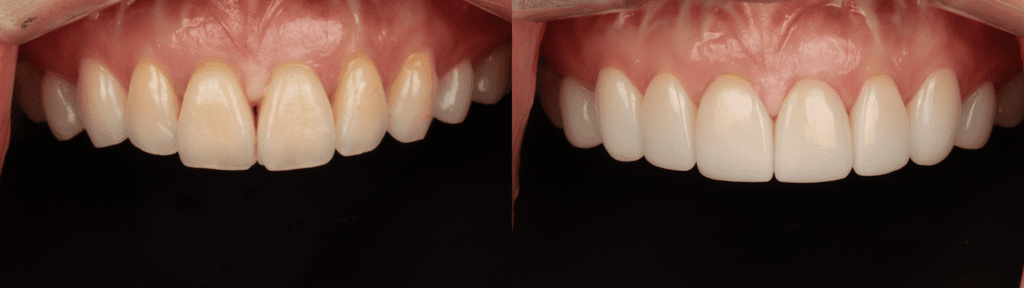
I see five common causes in the clinic. Only some of them are about the tooth itself.
1. Bone and gum loss. When the bone between the teeth becomes lower, the gum follows it down. This is the most common cause in adults.
2. Triangular tooth shape. Some teeth are wide at the edge and narrow near the gum. The contact point sits high, and a gap opens below it.
This is where veneers for black triangles tend to work best.
3. After orthodontic treatment. Crowded teeth that overlapped for years often hide a gap. Once they are straightened, the space appears.
4. Roots that lean apart. If the roots angle away from each other, the space between the crowns widens near the gum.
5. Inflammation or hard cleaning. Swollen gums can shrink after treatment. Very hard brushing can also flatten the papilla.
When Veneers for Black Triangles Work Well
Veneers work by changing the shape of the tooth walls. The ceramic can move the contact point lower and closer to the gum.
When the contact moves down, the remaining space becomes smaller. Often the gum can then fill it.
This works well in three situations:
- The teeth are triangular and the gum is healthy.
- The gap is small and limited to one or two spaces.
- You also want to change shape or colour, so the veneers serve more than one goal.
In these cases, we can often keep tooth preparation minimal. Our guide to no-prep veneers in Korea explains who qualifies.
When Veneers for Black Triangles Should Not Come First
Here is the part many patients do not hear. Closing a large gap with ceramic has a cost.
To fill a wide space, each veneer must become wider near the gum. The teeth start to look square and bulky.
That extra bulk can also trap plaque at the gum line. Inflamed gums then recede further, and the gap can return.
I would usually suggest another first step in these cases:
- Active gum disease — the gum must be stable before any shape change.
- Several wide gaps across the smile — this usually reflects bone level.
- Roots that lean apart — orthodontic uprighting can help before, or instead of, veneers.
- Healthy teeth you only want to close slightly — composite bonding may be enough.
Veneers for Black Triangles Compared With Other Options

This is the comparison I use during consultations.
| Option | Best suited for | Main limit | Tooth reduction |
|---|---|---|---|
| Porcelain veneers | Triangular teeth, small gaps, shape and colour change together | Too much bulk if the gap is wide | Minimal to light |
| Composite bonding | One or two small gaps on otherwise good teeth | Stains and wears faster | Usually none |
| Orthodontics | Roots leaning apart, gaps after crowding | Takes months | None, or slight reshaping |
| Gum treatment | Inflammation, early recession | Lost bone rarely grows back | None |
If you are weighing ceramic against resin, see porcelain vs composite veneers.
If a tooth is heavily restored, a crown may be the better choice. Our veneers vs crowns guide covers that decision.
How We Plan Veneers for Black Triangles
1. Check the gum first
We measure gum health and look at the bone on X-ray. A gap caused by active inflammation is not a veneer case yet.
2. Design the contact point
We decide how far down the contact should move. The goal is a natural shape, not simply a closed gap.
3. Try it before it is permanent
A mock-up shows the new width in your mouth. You can see whether the teeth start to look too square.
4. Make and fit the veneers
Our in-house lab, Blanche Lab, near Nonhyeon Station, shapes the edges next to the gum. Smooth edges matter here, because rough edges collect plaque.
Not sure where your case fits? Send two photos — front and smiling — on WhatsApp. We will tell you what is possible before you book any flight.
What Affects the Cost of Veneers for Black Triangles
The number of teeth changes the price most. But materials matter too.
The ceramic grade is only part of it. The bonding system also affects cost.
We use Ivoclar adhesive systems, which sit in the highest price range for dental adhesives. They are biocompatible, which supports your health, and they resist discolouration well.
That colour stability matters for black triangles. The bonded edge sits close to the gum, where staining shows first.
One-day veneers are priced higher than the standard schedule. Diagnosis, design, fabrication and adjustment are compressed into one day, with the dentist and lab team fully committed. Complex cases simply receive more design and adjustment time within that day.
Our prices are the same for international and Korean patients, with no foreigner surcharge. The item list is on our pricing page.
For the full one-day programme — technology, pricing and booking — see our One-Day Veneers page.
Not sure which group your gaps fall into? Send two smile photos before you travel, and we can give you a first view of your case.
The clinic is easy to reach from Incheon Airport by rail and subway.
Frequently Asked Questions
Do veneers for black triangles last permanently?
Veneers can close the visible space for many years. But if the gum or bone keeps receding, a new gap can appear. Gum care is part of the result.
Do veneers for black triangles make teeth look bigger?
Slightly wider, yes. With small gaps, the change is hard to notice. With wide gaps, the teeth can look square, which is why we mock up the result first.
Can fillers or gum treatment regrow the papilla?
Results are limited and often temporary. Lost bone rarely returns, so the gum has nothing to rest on. These options suit early, mild cases best.
Side effects and individual variation
After veneers, some patients feel temporary sensitivity or notice the new shape with their tongue. Gum response, bone level and daily cleaning vary between people, so results differ. This article is general information and does not replace an examination. Your treatment should be decided with a dentist after a clinical assessment.
A Final Word
After ten years in practice, I see it this way. A black triangle is usually a gum question, asked through the teeth.
When the teeth are the cause, veneers are an elegant answer. When the gum is the cause, we treat that first, and the smile holds up better for it.
What happens at your first consultation
1. We listen first — what bothers you and what you hope for. 2. We walk you through your scan results and every option.
3. You get itemized costs and timing, and you can decide later, even after you fly home. At Blanche, we explain everything at least four times, by principle.
Consultation — Blanche Dental Clinic sits between Nonhyeon and Sinnonhyeon stations in Gangnam, Seoul. To ask about your own case, message us on WhatsApp, or review item-by-item costs on our pricing page. Consultations are available in English, Japanese, Chinese, Thai and Russian.
Written by Dr. Kim Tae-hyung (Director, Blanche Dental Clinic · Seoul National University-trained dentist)