
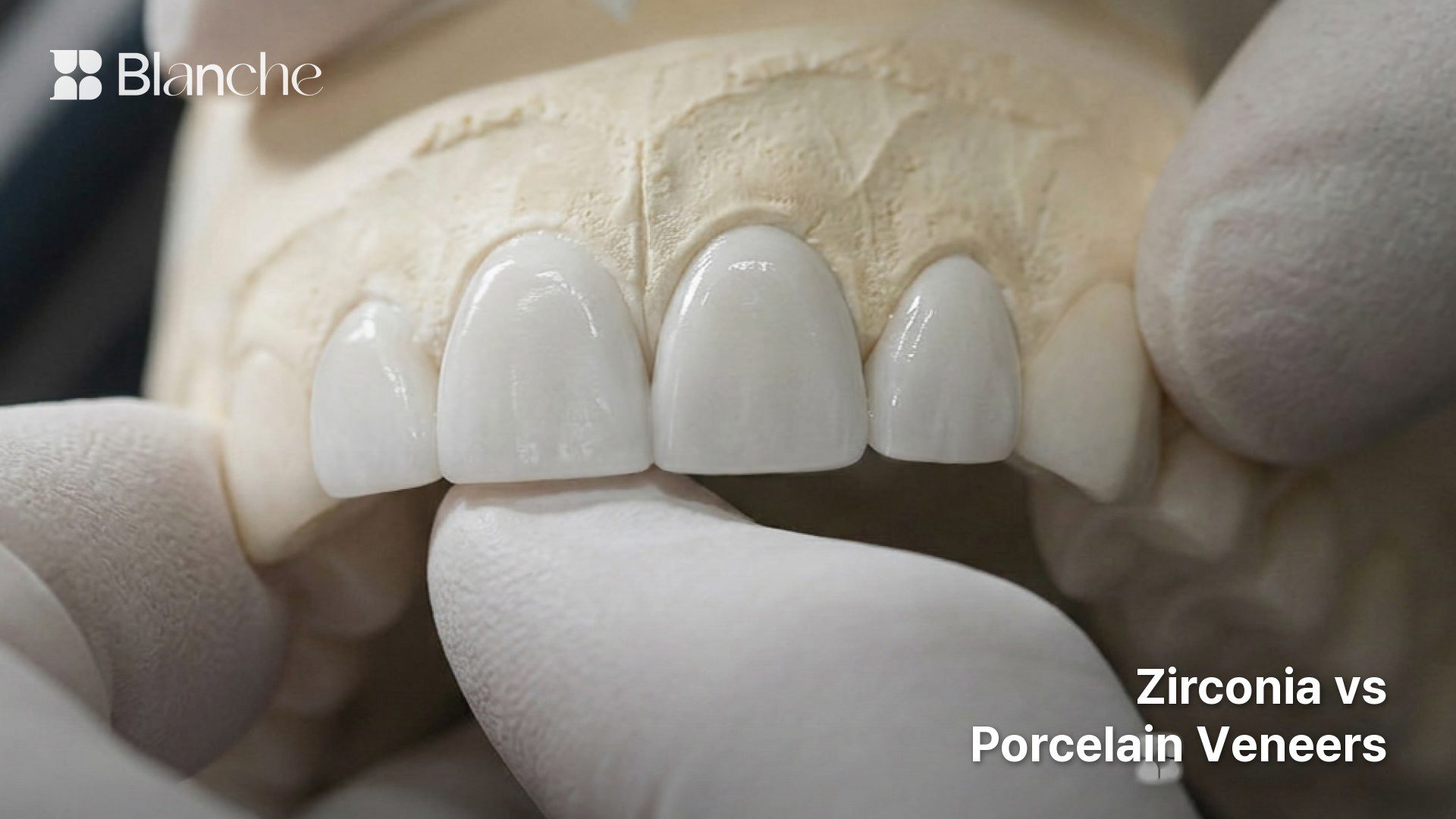
Zirconia veneers vs porcelain veneers is a question that usually starts with one word you read online: “strongest.” Someone wrote that zirconia hardly ever chips, and now porcelain sounds like the weaker choice.
The worry underneath is simple. You don’t want front teeth that crack a year after you fly home. However, you also don’t want teeth that look flat, like piano keys.
Below, I compare the two materials in general terms. Then I explain why Blanche (BLANCHE), the treatment we do in Gangnam, is made from a different ceramic.
A note from Dr. Kim
I understand the pull of the word “strongest,” because nobody wants to worry about a chip after a long flight home.
Why damage a tooth worth more than you can price? Blanche started from that question.
That answer is Blanche, Front Tooth Reinforcement Therapy.
Zirconia veneers vs porcelain veneers: two different ceramics
Both are ceramics, so both are tooth-colored and contain no metal. That said, they are built very differently.
Zirconia is a dense, crystal-based ceramic. In dentistry it is widely used for crowns, bridges and implant crowns, because it holds up well under heavy chewing.
“Porcelain” is a looser word. It usually means glass-based ceramics, such as feldspathic porcelain, which a ceramist can build up by hand in very thin layers.
So the real comparison is not “strong versus weak.” It is closer to “made for heavy loads” versus “made for thin layers and light.”
Strength, translucency and thickness, side by side
Products vary, and newer zirconia types let more light through than older ones. So treat this as a general starting point.
| Zirconia (in general) | Feldspathic porcelain (in general) | |
|---|---|---|
| What it is | Dense, crystal-based ceramic | Glass-based ceramic, often layered by hand |
| Strength on its own | Very high fracture resistance | Lower; relies on a close bond to enamel |
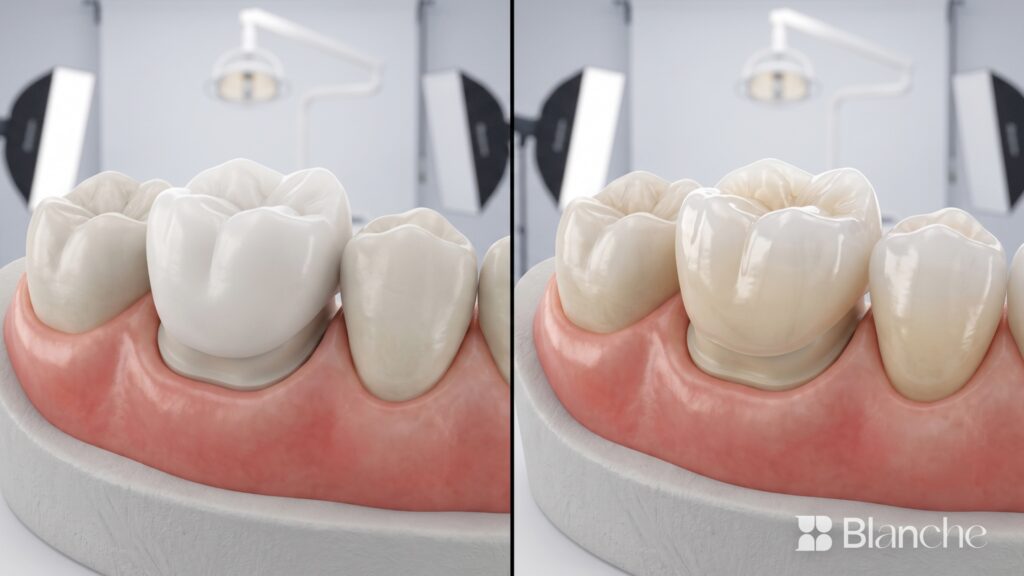
| How light passes | More opaque, though newer types are clearer | Lets light through in a way that can resemble enamel |
| Thickness | Usually needs some thickness to work well | Can be made in very thin layers |
| Bonding | Needs its own bonding protocol | Can be etched and bonded closely to enamel |
| Where it often fits | Crowns, bridges, back teeth, implant crowns | Thin layers on front teeth |
Why translucency matters more on front teeth
Natural enamel is not solid white. Light enters it, scatters, and comes back out, so the edges of front teeth often look slightly see-through.
Think of a paper lampshade next to a porcelain one. Switch the lamp on, and only the paper shade glows. Front teeth behave more like the paper.
That is why the material that suits a molar is not automatically right for an incisor. On a back tooth, chewing load comes first. On a front tooth, how light passes through matters much more.
Material is only part of a natural look, though. Shape, shade and the bonding edge count too, as our post on why some veneers look natural and others do not explains.
Where zirconia shines: crowns and implants
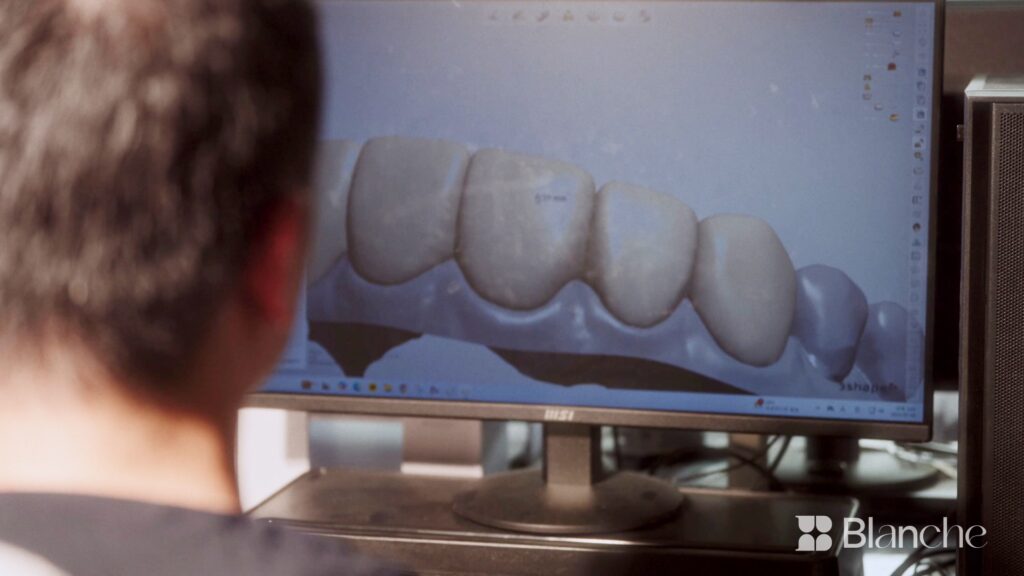
None of this makes zirconia a poor material. It is a good material for crowns, and at our clinic it goes into implant crowns and full-arch implant bridges. Those teeth carry heavy chewing loads, and zirconia suits that job.
A zirconia crown can also make sense when a tooth has lost a large part of its structure, for example after a big fracture. Our guide to zirconia crowns in Korea explains when a crown is needed.
So the honest summary of zirconia veneers vs porcelain veneers is this: each material has a job. The real question is which job your front teeth need done.
Why Blanche is made from Swiss feldspathic ceramic
Blanche is not an ordinary veneer. It’s Front Tooth Reinforcement Therapy. Instead of shaving your teeth down to cover them, Blanche adds a thin layer onto the teeth you already have.
That goal decides the material. Every Blanche is made by Blanche Lab from the Blanche Block, in Swiss feldspathic ceramic rather than zirconia.
Why that family of ceramic? Because Blanche goes on fully no-prep, or with minimal prep under 0.1 mm. The material has to work as a thin layer bonded to enamel, and a glass-based ceramic that can be layered and etched fits that job.
How the ceramic is made at each tier
At BASIC (KRW 650,000 per tooth, VAT excluded), a Blanche Lab ceramist shapes Swiss ceramic with CAD/CAM. At PLATINUM (KRW 850,000), a senior ceramist hand-layers it and fires it at about 800°C. At Signature PLATINUM (KRW 1,500,000), I take charge with a dedicated ceramist.
Our ceramists trained in France and Switzerland, and we bond with an Ivoclar adhesive system that resists edge discoloration. Our page on Front Tooth Reinforcement Therapy explains who Blanche suits.
Which material would my front teeth actually need?
Send us just two photos: one of your face straight on, and one smiling. We’ll tell you whether your teeth look suited to no shaving at all, and what we would check at the exam.
Questions to ask about zirconia veneers vs porcelain veneers
Whichever clinic you visit, the zirconia veneers vs porcelain veneers choice is only one line of the quote. So ask a few more questions.
- Which material, by name, and why does it suit my teeth?
- How much of my tooth will be shaved, in millimetres?
- Who makes the piece, and where is the lab?
If a clinic recommends zirconia for a front tooth, ask why. There may be a good reason, such as a tooth that truly needs a full crown.
Finally, start with photos, not flights. We are a 30-second walk from Nonhyeon Station Exit 4 in Gangnam, about an hour from Incheon Airport.
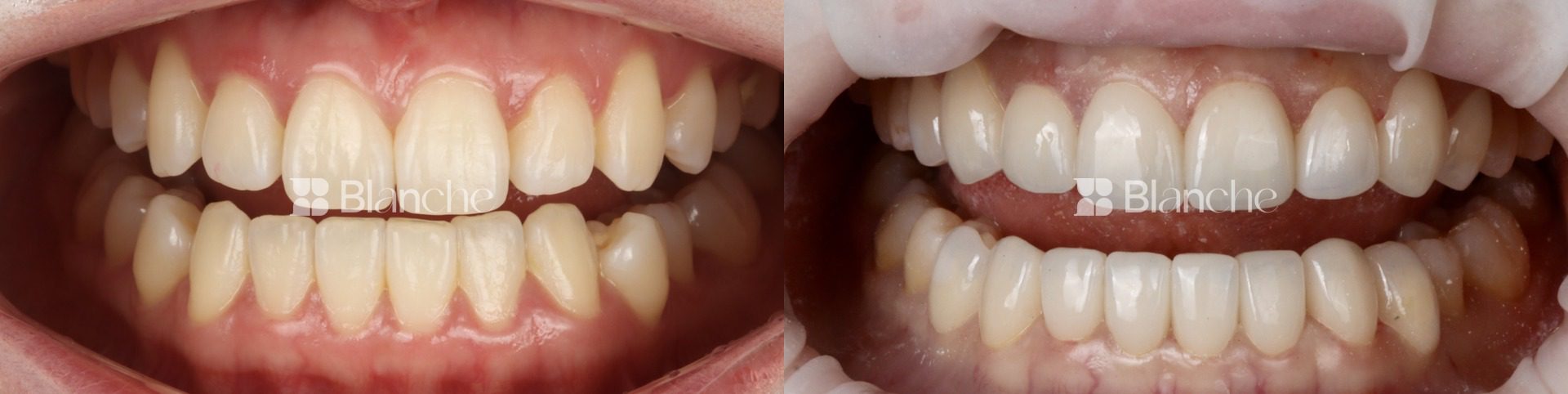
An actual case treated at Blanche Dental Clinic. Results vary with each patient’s dental condition.
Frequently asked questions
Zirconia veneers vs porcelain veneers: which is stronger?
In general, zirconia has higher fracture resistance on its own. However, a thin ceramic bonded closely to enamel works differently, so strength alone does not decide.
Does Blanche Dental Clinic use zirconia?
Yes, for implant crowns and full-arch implant bridges. Blanche itself is made by Blanche Lab from the Blanche Block, in Swiss feldspathic ceramic rather than zirconia.
Will porcelain look more natural than zirconia on my front teeth?
Often, porcelain lets light through in a way closer to enamel, although zirconia types vary. Shape, shade layering and the bonding edge matter too, so we judge it on your teeth.
Side effects and individual differences
Temporary sensitivity, a foreign-body feeling, or mild gum swelling can occur. Results and longevity vary with each person’s teeth and habits.
When I teach other dentists, I say the material is the last decision, not the first. We study the tooth, decide how little to change, and only then choose the ceramic, so your smile still works twenty years from now.
How your first consultation works
1. We listen to your concerns and the smile you want.
2. Based on your exam, we explain every available option.
3. We give itemized costs and timelines. You are welcome to decide later, at home.
We repeat every explanation at least four times, and no decision depends on one person’s judgment alone.
Consultation — Message us on WhatsApp with two smile photos, or check our pricing. Same pricing for Korean and international patients.