
Eating with veneers is the question patients ask last and worry about most. It usually arrives at the end of a consultation, half apologetically, right after the cost questions.
The honest answer is that very little changes forever. Quite a lot changes for about two days.
Think of porcelain like a tile bonded to a wall. Press straight into it and nothing happens. Catch its edge sideways, over and over, and the bond gives way before the tile does.
This guide covers the first 48 hours, the four forces that actually matter, and how to plan meals if you are flying home soon after treatment.
A note from Dr. Kim — Many people who land on this page share one quiet worry: what if I damage healthy teeth for nothing? It is the first question I ask myself with every patient.
Blanche began with that question: why harm a natural tooth worth more than any restoration? That is why our signature Blanche no-prep veneers follow one rule — minimal intervention, maximum beauty.
Eating With Veneers in the First 48 Hours
The porcelain itself is at full strength the moment it is placed. The bonding layer underneath is not.
Modern adhesive systems reach most of their strength within minutes and the rest over the next day or two. That gap is the only reason the first 48 hours have rules at all.
What to skip for two days
- Biting straight through hard items — apples, carrots, crusty bread. Cut them and use your back teeth instead.
- Very hot and very cold in the same meal — soup followed by iced water. Rapid swings can stress a fresh bond line.
- Sticky sweets — caramel and toffee pull upward on the edge of a veneer, which is the direction it likes least.
- Deeply pigmented drinks — coffee, red wine, and curry sauces. This is about the bonding line, not the porcelain.
That last point surprises people. Porcelain does not absorb colour, but the thin resin margin around it can pick up stain while it is still settling. We cover the longer story in our guide to what actually discolours veneers.
What you can eat immediately
Almost everything else. Rice, noodles, eggs, fish, cooked vegetables, soft fruit, yoghurt, and anything you would cut with a fork.
Patients are often relieved to hear that there is no liquid diet involved. You are avoiding four specific forces, not food in general.
Eating With Veneers: The Four Forces That Decide How Long Porcelain Lasts
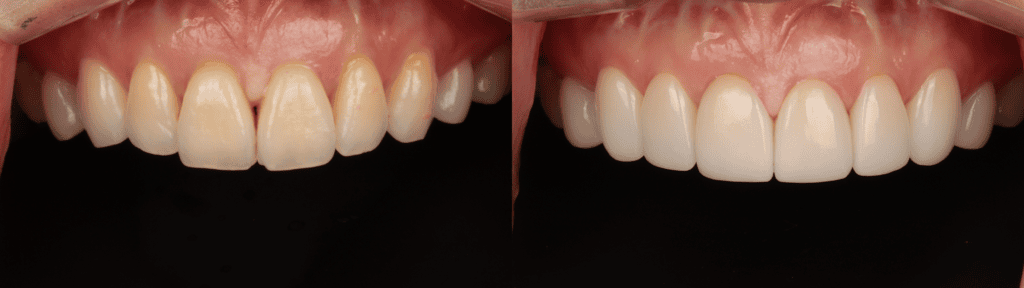
Once the bond has matured, the rules stop being about time and start being about direction. These are the four things we actually watch.
| Force | Typical source | Why it matters | Practical habit |
|---|---|---|---|
| Shear (sideways) | Biting through apples, tearing bread, opening packaging | Pulls at the bonded edge rather than the porcelain face | Cut first, chew with back teeth |
| Point load | Ice, popcorn kernels, olive pits, bones | Concentrates force on one spot of a thin edge | Avoid deliberately, check food for hidden hard pieces |
| Thermal swing | Hot soup then iced drinks | Porcelain and tooth expand at slightly different rates | Leave a short gap between temperature extremes |
| Acid exposure | Citrus, soda, sparkling water, wine | Softens the natural tooth around the margin over years | Rinse with water, wait before brushing |
None of these forces requires giving anything up permanently. Each one has a small habit that neutralises it.
The one habit worth changing for good
If you take only one thing from this article, make it this: stop using your front teeth as tools.
Tearing tape, holding hairpins, cracking sunflower seeds, opening bottles. Those actions load a veneer edge sideways at high force, which is the exact direction the bond is weakest in.
Eating With Veneers During the Temporary Stage
Temporaries are held on with a deliberately weak cement so they can be removed cleanly. They are not weaker porcelain, they are a different attachment altogether.
So during this stage the rules are genuinely stricter. Avoid sticky foods entirely, cut everything, and chew on your back teeth.
If a temporary does come off, keep it and call the clinic. It is a scheduling matter, not an emergency. Our article on what temporaries do and when you never need them explains why some treatment plans skip this stage entirely.
Planning Meals Around a Treatment Trip
If you are travelling to Seoul for treatment, the food question becomes a scheduling question. Two details are worth planning around.
First, avoid strongly coloured food on the day your shade is chosen. Coffee and curry leave surface stain that makes it harder to read your natural base colour accurately.
Second, plan your last meal before the flight rather than on it. Airline meals arrive at unpredictable temperatures, and cabin snacks are often exactly the hard, dry items worth skipping on day one.
For patients finishing treatment in a single day, the bonding is complete before you leave the clinic, so the 48-hour clock simply starts earlier. For the full one-day programme, including technology, pricing, and booking, see our One-Day Veneers page.
What our pricing includes
Our fees are the same for Korean and international patients, with no foreigner surcharge. You can see the published figures on our pricing page.
One cost factor that is rarely itemised elsewhere is the adhesive system. We use Ivoclar bonding, which sits at the top of the price range for dental adhesives but offers strong biocompatibility and excellent colour stability over time.
That matters directly to this article. A margin that yellows is what makes an otherwise good veneer start to look obvious after a few years.
Our in-house laboratory, Blanche Lab, is inside the clinic near Nonhyeon Station, so shade and fit are checked against your actual teeth rather than a photograph.
Not sure where your case fits? Send two photos — front and smiling — on WhatsApp. We will tell you what is possible before you book any flight.
Eating With Veneers and Daily Care, Beyond the Table

Eating is one half of the picture. The other half is what happens between meals.
Flossing matters more after veneers, not less, because the margin sits where plaque likes to gather. Our veneers aftercare guide covers brushing pressure, floss technique, and the check-up schedule in detail.
If you are unsure whether a specific habit of yours is a problem, send us a photo and describe it. It is easier to answer a real case than a general one.
Frequently Asked Questions
Q. Can I drink coffee after getting veneers?
Yes, after the first 48 hours. The porcelain does not absorb colour, but the thin resin margin can pick up stain while the bond is still maturing, so we ask patients to wait two days and then rinse with water afterwards.
Q. Will eating with veneers feel different?
For a few days, yes. Your tongue notices the new edges and your bite is registering slightly different contact points, and both usually settle within a week.
Q. Can I bite into an apple again?
Most patients do, once the bond has matured. We still suggest slicing hard fruit as a habit, because sideways force on the incisal edge is the single most common cause of chipping.
Side Effects and Individual Variation
Temporary sensitivity to hot and cold, mild gum tenderness at the margin, and a short adjustment period in chewing and speech are all common after treatment. These usually resolve within days.
How quickly they settle depends on how much enamel remains, your gum condition, and your bite pattern. This article describes general patterns and does not apply identically to everyone. An in-person examination is required for any individual assessment.
A Closing Note
Patients often expect to be handed a long list of forbidden foods. In practice the list is short, and most of it applies for two days rather than forever.
What lasts is the habit change: cut hard things, keep your front teeth out of jobs that tools should do. That single adjustment protects the edge far more than any dietary restriction.
If you want to know how your own bite pattern affects this, a photo and a short description are enough to start the conversation.
What happens at your first consultation
1. We listen first — what bothers you and what you hope for. 2. We walk you through your scan results and every option.
3. You get itemized costs and timing, and you can decide later, even after you fly home. At Blanche, we explain everything at least four times, by principle.
Consultation — Blanche Dental Clinic is located between Nonhyeon and Sinnonhyeon Station in Gangnam, Seoul. You can reach us on WhatsApp for a photo consultation, and our published fees are on the pricing page.
Written by Dr. Kim Tae-hyung (Director, Blanche Dental Clinic · Seoul National University trained dentist)