

A black line around veneers is one of the most common reasons people ask for a second opinion, and one of the most misread. You notice it in a photo first: the teeth look fine, but a thin dark edge runs along the gum line, and suddenly that is all you can see.
Most patients assume the veneer has failed. Often it is intact, and the darkness is coming from something behind it or beside it.
This article separates the five things that create that line. Each shows up in a different place, and each has a different answer, so the first job is telling them apart.
A note from Dr. Kim — Many people who land on this page share one quiet worry: what if I damage healthy teeth for nothing? It is the first question I ask myself with every patient.
Blanche began with that question: why harm a natural tooth worth more than any restoration? That is why our signature Blanche no-prep veneers follow one rule — minimal intervention, maximum beauty.
Why a black line around veneers starts at the margin
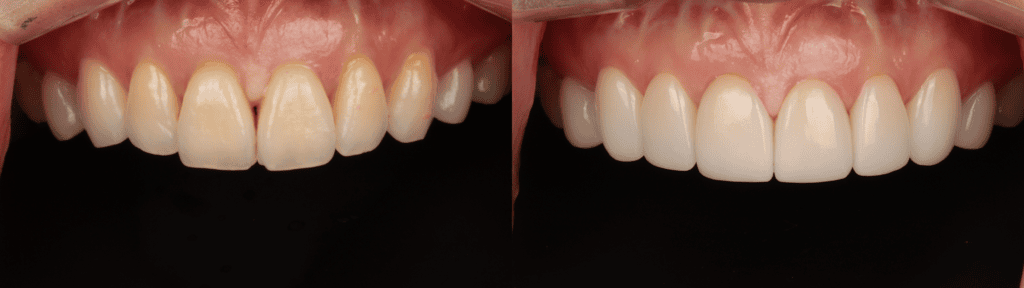
Every veneer ends somewhere. That ending is called the margin, and it is the most demanding millimetre in the whole restoration.
Think of wallpaper meeting a skirting board. The paper can be flawless, but if the seam sits slightly proud, or the wall behind it is darker, your eye goes straight to the join.
Porcelain is translucent, so it does not hide what sits underneath. A margin that is thick, poorly polished, or placed over a dark surface reads as a line even when the bond is sound. The useful question is therefore not whether the veneer has failed, but where the darkness is coming from.
A black line around veneers: five causes, and where each one shows up
1. A metal core underneath — which means it is not a veneer
The classic dark band at the gum belongs to an older porcelain-fused-to-metal crown, not to a veneer. A thin metal collar sits at the margin. As the gum settles over the years, it shows as a grey stripe.
Many people who describe this to us are in fact wearing crowns placed years ago. Check this first, because the answer is a change of restoration type, not a repair.
2. Stain sitting in the margin, not under it
Coffee, tea, red wine and tobacco pigment collect in any microscopic roughness at the join. The result is a brown-to-black line that follows the veneer edge exactly.
This one is good news. It sits on the surface, and a professional clean with a repolish usually removes it.
3. Cement breakdown at the join
The bonding layer is only a few microns thick, but it ages. If it degrades, the join opens fractionally and picks up pigment from inside.
This darkness does not polish off, and it often arrives with mild sensitivity. Bonding quality matters more here than patients expect. We use the Ivoclar adhesive system for that reason: it is at the top of the price range for adhesives, and it holds colour stability and biocompatibility far better than cheaper alternatives.
4. The tooth underneath has darkened
A tooth treated with root canal therapy, or one that carried a large old filling, can be several shades darker than its neighbours. Under thin, translucent porcelain that shadow shows through. It is strongest near the gum, where the veneer is thinnest.
Here the veneer is not at fault. The answer is a more opaque ceramic or an internal masking layer, decided at the design stage rather than afterwards.
5. The gum itself is pigmented
Sometimes the dark area is in the tissue, not on the tooth. Natural melanin pigmentation, or a grey patch left by an old metal restoration, sits exactly where you expect a margin.
Tell them apart by the edge. Pigment in the gum is soft and irregular. A margin line is sharp, and it follows the curve of the restoration precisely.
| Cause | Where the darkness sits | Sharp or soft edge | What it usually needs |
|---|---|---|---|
| Metal core beneath a crown | Narrow band at the gum | Sharp | Change to an all-ceramic restoration |
| Surface stain in the margin | On the join line | Sharp | Clean and repolish |
| Cement breakdown | Inside the join | Sharp, often with sensitivity | Remake of that unit |
| Darkened tooth showing through | Broad shadow near the gum | Soft, diffuse | Redesign with masking |
| Gum pigmentation | In the tissue itself | Soft, irregular | Assessment of the tissue, not the veneer |
How we check a black line around veneers in the chair

The examination follows a fixed order. First we dry the area and look under magnification. Surface stain lifts visibly when dried; darkness from beneath does not change.
Next comes a radiograph, which shows any metal substructure and whether the margin has opened. Then we compare the tooth shade against its neighbours. A broad shadow rather than a line points to the tooth beneath.
Only then do we discuss treatment. A stained margin and a failing seal look identical in a selfie. One takes twenty minutes; the other means a remake.
What prevents a black line around veneers in the first place
Prevention is mostly a design decision, and three choices carry the weight.
The first is where the margin sits. Finished slightly away from the gum edge, on sound enamel, it stays cleanable. It also does not depend on the gum staying exactly where it is today.
The second is the ceramic. Fully ceramic materials have no metal core, so no grey band is possible, and opacity can be tuned to the shade underneath. Our veneers shade guide explains what A1, B1 and BL mean in practice, and natural looking veneers covers the same design thinking applied to shape.
The third is the bond. A well-sealed, colour-stable adhesive layer keeps the join from opening and picking up pigment.
Not sure where your case fits? Send two photos — front and smiling — on WhatsApp. We will tell you what is possible before you book any flight.
Planning a visit from abroad
Most patients who travel to us send photographs first. That usually tells us before you book whether this is a polish or a remake. Prices are the same for Korean and international patients, and figures are on the pricing page.
Blanche Dental sits between Nonhyeon and Sinnonhyeon stations in Gangnam, Seoul. Our in-house laboratory, Blanche Lab, lets diagnosis, design, fabrication and fitting finish in a single day. One-day treatment is priced higher than the conventional route, because compressing those stages commits the dentist and the technical team to your case for the whole day.
For the full one-day programme — technology, pricing, and booking — see our One-Day Veneers page. Afterwards, our veneers aftercare guide covers the routine that keeps margins clean.
Frequently asked questions
Can a black line around veneers be polished away?
Sometimes. Surface pigment held in a rough margin usually comes off with a clean and a repolish. Darkness from a metal core, a degraded cement layer or the tooth beneath will not change.
Does a dark edge mean my veneers have to be replaced?
Not automatically. Replacement is indicated when the join has opened, or when a metal substructure is showing. A shadow from the tooth beneath, or pigment in the gum, is a different problem.
How long after treatment does a dark line usually appear?
Surface staining can build within a year with heavy coffee or tobacco use. Cement breakdown and gum change more often show after several years. A line appearing within weeks of fitting should be reviewed promptly.
Side effects and individual variation
The timeframes here are general. Findings vary with the existing restoration, gum condition, bite and oral hygiene. Any restorative treatment carries a risk of sensitivity, gum irritation, or the need for adjustment. Nothing here is a diagnosis or a guarantee of a result, and decisions should follow an in-person examination.
A black line around veneers: a closing note from the clinic
Patients who arrive with this concern are rarely unhappy with the shape or colour of their teeth. They are unhappy with one line, and they have usually been told it is nothing to worry about.
It is worth identifying properly. Knowing which of the five causes you have is the difference between a short appointment and a full remake, and photographs are usually enough for us to point you in the right direction.
What happens at your first consultation
1. We listen first — what bothers you and what you hope for. 2. We walk you through your scan results and every option.
3. You get itemized costs and timing, and you can decide later, even after you fly home. At Blanche, we explain everything at least four times, by principle.
Consultation — Blanche Dental is located between Nonhyeon and Sinnonhyeon stations in Gangnam, Seoul. You can reach us on WhatsApp for a photo consultation, and treatment fees are listed on our pricing page.
Written by Dr. Kim Tae-hyung (Director, Blanche Dental · Seoul National University-trained dentist)