
Are no prep veneers reversible? It is one of the first questions people ask once they hear that no drilling is involved. The idea makes sense. If nothing is removed, surely you can go back.
The honest answer is “mostly, but not in the way most people imagine.” Many patients who ask this are not planning to remove anything. They simply want to know the decision is not a trap.
This guide explains what happens to your tooth when a no-prep veneer comes off, what “reversible” can and cannot mean, and how to keep your options open from the start.
A note from Dr. Kim — Many people who land on this page share one quiet worry: what if I damage healthy teeth for nothing? It is the first question I ask myself with every patient.
Blanche began with that question: why harm a natural tooth worth more than any restoration? That is why our signature Blanche no-prep veneers follow one rule — minimal intervention, maximum beauty.
Are No Prep Veneers Reversible? The Short Answer
No-prep veneers are bonded to your natural enamel without shaving it down first. Because the enamel stays in place, a dentist can remove the veneer later and your own tooth is still there underneath.
That is very different from conventional veneers. With those, a layer of enamel is removed to make room, and that enamel never grows back.
So the more accurate word is “conservative.” The treatment is designed so that going back remains possible. It is not like peeling off a sticker, though.
Are No Prep Veneers Reversible in Every Case?
To bond porcelain to enamel, the tooth surface is gently conditioned so the adhesive can grip it. When the veneer is removed, a thin trace of that bond remains on the surface.
The dentist then polishes the tooth to remove the leftover adhesive. The tooth is intact, but it is not exactly the same surface you had before treatment.
In most cases the difference is not visible. Still, it is fair to call no-prep veneers “largely reversible” rather than “fully reversible.”
No Prep Veneers Reversible in Practice: What Removal Involves
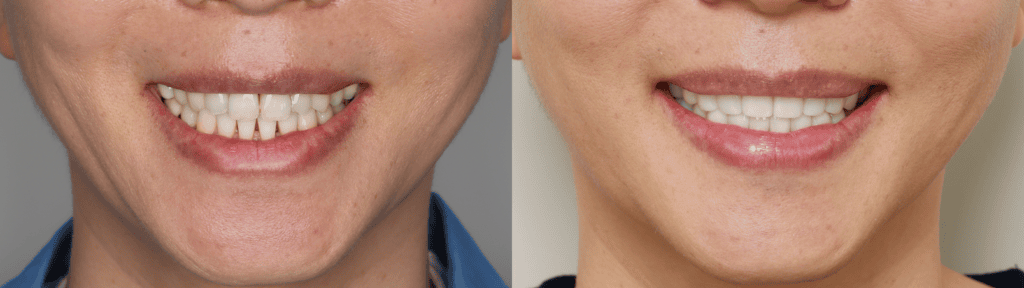
Removal is a planned procedure, not something you do at home. It usually follows three steps.
1. Separating the porcelain. The dentist carefully removes the porcelain shell. The aim is to take off the veneer without touching the enamel underneath.
2. Cleaning off the adhesive. A thin layer of bonding material stays on the tooth. It is removed slowly and the surface is checked under magnification.
3. Polishing and checking color. The tooth is polished smooth. We then check the color, because natural teeth can look slightly different after years under a veneer.
No Prep Veneers Reversible or Not: How the Options Compare
The table below shows what is left behind when each type of veneer comes off.
| No-prep veneers | Minimal-prep veneers | Conventional veneers | |
|---|---|---|---|
| Enamel shaved before bonding | None | A very thin layer in selected spots | A full layer on the front surface |
| Tooth after removal | Your own enamel, polished | Mostly your own enamel | Shaved tooth that needs covering again |
| Can you go without a veneer afterward? | Usually yes | Often yes | Usually no |
| Best described as | Largely reversible | Conservative | Permanent commitment |
The key difference is not the brand name or the thickness. It is how much of your enamel remains once the porcelain is gone.
If you want to understand how shaving affects enamel in conventional cases, read Do Veneers Ruin Your Teeth?
Why Keeping No Prep Veneers Reversible Matters Later
Most no-prep veneers are never removed on purpose. When they are, it is usually for one of these reasons.
A change in color preference. Some people chose a very bright shade years ago and now want something softer. Replacing the porcelain is simpler when the enamel underneath was never shaved.
Moving teeth with orthodontics. Occasionally a patient decides to straighten teeth with aligners later. Veneers may be removed first so the teeth can move freely.
Wear, chips, or gum changes. Over many years, edges can chip or gums can shift. A new veneer can be made on the same untouched tooth.
If a veneer comes loose unexpectedly, that is a different situation. We explain it in Do Veneers Come Off?
How to Keep No Prep Veneers Reversible From Day One

Reversibility is not only about the veneer. It depends on decisions made before bonding.
Start With the Right Case
No-prep works best for small teeth, gaps, and teeth that sit slightly inward. If a tooth already sticks out, adding porcelain can make it look bulky.
In that situation, trimming a tiny amount can look more natural. If teeth are clearly crooked, we recommend orthodontics first, because it protects the most tooth structure.
Design Before You Bond
We design the smile first and preview it with a mock-up. That way you see the result before anything is permanent.
Our in-house lab, Blanche Lab, makes each veneer on site, so thickness and color can be adjusted the same day.
Choose the Bonding System Carefully
Thin porcelain depends heavily on the adhesive layer. It affects how the veneer holds, how its edges age, and how cleanly it can be removed.
We use the Ivoclar bonding system, which sits in the highest price range among dental adhesives. It is biocompatible and has excellent color stability, so edges resist staining.
This is one reason veneer prices differ between clinics. Porcelain grade is only part of the cost.
Not sure where your case fits? Send two photos — front and smiling — on WhatsApp. We will tell you what is possible before you book any flight.
Planning No-Prep Veneers in Seoul
Our clinic is between Nonhyeon and Sinnonhyeon stations in Gangnam. It is a straightforward trip from Incheon Airport by airport bus or train.
Foreign and Korean patients pay the same price. You can send photos before you fly, and we will tell you whether no-prep or minimal-prep suits your teeth.
For cost details and who qualifies, see No-Prep Veneers in Korea. For the full one-day program — technology, pricing, and booking — see our One-Day Veneers page.
If you want to know whether your case could stay reversible, a photo consultation is a good first step.
Frequently Asked Questions
Q. Are no prep veneers permanent?
They are designed to last many years, but they are not a permanent change to your tooth. Because the enamel is kept, they can be replaced or removed later.
Q. Can no prep veneers be removed without damage?
In most cases, yes. A trace of adhesive stays on the enamel and is polished away. The tooth underneath remains your own.
Q. Are minimal prep veneers reversible too?
Often, yes. Minimal prep removes only a very thin layer in selected spots, so most enamel stays. The less shaving, the more options you keep.
Side Effects and Individual Differences
Temporary sensitivity or a foreign-body feeling can occur after treatment. Results vary with each person’s teeth, so the method should be decided after an examination and consultation.
I am a dentist trained at Seoul National University, and I have spent ten years working mainly with veneers. My principle is simple: keep as much of your own tooth as the result allows.
At our clinic this approach has a name: Blanche no-prep veneers. The goal is always to keep your enamel where it belongs.
If you would like to know how reversible your own case could be, we can start from photographs.
What happens at your first consultation
1. We listen first — what bothers you and what you hope for. 2. We walk you through your scan results and every option.
3. You get itemized costs and timing, and you can decide later, even after you fly home. At Blanche, we explain everything at least four times, by principle.
Consultation — Blanche Dental Clinic is located between Nonhyeon and Sinnonhyeon stations in Gangnam, Seoul. You can reach us on WhatsApp for a photo consultation, and our pricing page lists treatment fees in advance.