

You have been quoted for a smile makeover, and somewhere in the notes there is a line about bleeding gums. So can you get veneers with gum disease, or does that line stop everything?
It is one of the most common questions we get from patients planning treatment abroad. The honest answer has two parts, and the second part is the one that protects your result.
A note from Dr. Kim — Many people who land on this page share one quiet worry: what if I damage healthy teeth for nothing? It is the first question I ask myself with every patient.
Blanche began with that question: why harm a natural tooth worth more than any restoration? That is why our signature Blanche no-prep veneers follow one rule — minimal intervention, maximum beauty.
Can you get veneers with gum disease?
Not on untreated gums. That is the short version.
Porcelain can be bonded to a tooth whose gums are inflamed. It will look fine on the day. The problem arrives later, and it arrives from the gum line down.
Think of a tent. The fabric can be beautiful, but if the ground under the pegs is soft, the shape shifts no matter how good the fabric is. Your gum and the bone beneath it are that ground.
Gingivitis and periodontitis are not the same problem
Gingivitis is inflammation of the gum tissue. It is reversible. Once plaque and calculus are removed and home care improves, the tissue tightens back up.
Periodontitis is different. Here the bone that holds the tooth has already been lost, and bone does not grow back on its own.
That distinction decides your timeline. Gingivitis usually means a short delay. Periodontitis means a longer plan, and sometimes a different plan altogether.
Veneers with gum disease: what inflamed gums do to a margin
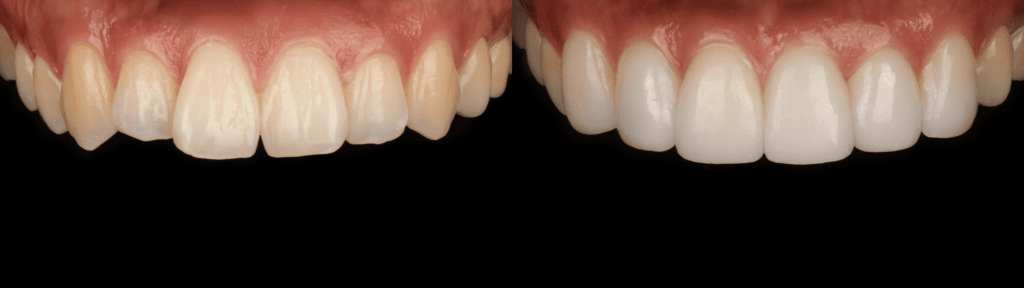
A veneer has an edge where porcelain meets tooth. That edge sits at or just under the gum line, and it is the most demanding millimetre of the whole treatment.
When gums are inflamed, four things work against that edge.
| What happens | Why it matters for the veneer |
|---|---|
| Gums bleed during bonding | Moisture contaminates the bonding surface, and bond strength drops |
| Swollen tissue sits higher | The margin is placed against a gum line that will move once swelling settles |
| Tissue recedes after treatment | A previously hidden margin becomes visible as a line |
| Bone loss continues | Teeth can loosen or drift, and the new smile line shifts with them |
The first row is the one people underestimate. Bonding is a chemical process, and it is unforgiving about moisture.
This is also where the bonding system itself matters. We use the Ivoclar adhesive system, which sits at the higher end of the price range for a reason: it is biocompatible and it resists discolouration over time, so the margin stays quieter as the years pass.
Veneers with gum disease: the sequence that actually works
Treating gums first is not a delay tactic. It is what makes the final position of the margin predictable.
A typical order looks like this.
- Diagnosis. Pocket depths are charted and X-rays are checked for bone level.
- Gum treatment. Scaling, and deeper cleaning below the gum line if pockets are involved.
- Healing. Tissue is allowed to settle so the gum line stops moving.
- Re-assessment. Bleeding on probing is checked again before anything cosmetic begins.
- Veneer planning. Shade, shape and margin position are decided on stable tissue.
Step four is the checkpoint. If gums still bleed when touched, the margin position cannot be trusted yet.
A word about clinics that skip it
If a quote arrives before anyone has looked at your gums, treat that as a signal. The same applies if periodontal treatment is never mentioned at all.
Cosmetic work placed on unstable tissue tends to need redoing, and redoing costs more than waiting did.
Veneers with gum disease: how to tell if your gums are ready

You cannot diagnose yourself, but you can arrive informed. These are the signs worth noting before a consultation.
- Bleeding when you brush or floss, even occasionally
- Gums that look puffy or rolled rather than firm and scalloped
- Persistent bad breath that returns quickly after brushing
- Teeth that look longer than they used to
- Any sense that a tooth moves slightly
The fourth item is receding tissue, and it changes what a veneer can achieve. Porcelain covers the front of a tooth. It does not raise a gum line back to where it was.
Cases differ widely here. One patient may need a single cleaning appointment and a few weeks. Another may need periodontal care first and a staged plan over months.
Planning veneers with gum disease from another country
Most of our international patients want to know one thing: can this still be done in a single trip?
Often yes, but it depends on what the photographs show before you fly. Send clear photos of your teeth and gums in advance, and we can tell you whether gum treatment needs to happen at home first or can be handled here.
That pre-travel photo consultation is the single most useful step for anyone booking from abroad. It is also how we avoid the worst outcome, which is arriving with a fixed return flight and an unexpected gum problem.
Our clinic is in Gangnam, between Nonhyeon and Sinnonhyeon stations, and roughly an hour from Incheon Airport. We run our own in-house laboratory, Blanche Lab, so design and fitting happen in the same building.
Same-day treatment is priced higher than a standard schedule, because diagnosis, design, fabrication and adjustment are compressed into one day with the dentist and lab team working together throughout. More complex cases simply receive more design and adjustment time within that day. For the full one-day programme — technology, pricing and booking — see our One-Day Veneers page.
Our fees are the same for Korean and international patients. There is no foreigner surcharge.
What happens after the veneers are placed
Gum health does not stop mattering once porcelain is on. If anything, the margin makes daily cleaning more important, not less.
The routine is covered in detail in our guide to veneers aftercare, and the treatment sequence itself is set out in the veneers process, step by step.
Frequently asked questions
Can I get veneers with gum disease if it is mild?
Mild gingivitis is usually treated first, and the delay is short. A cleaning and improved home care often settle the tissue within a few weeks. The point is not the severity label but whether the gum line has stopped moving before the margin is placed.
Will veneers cover receding gums?
No. A veneer covers the front surface of a tooth, so it cannot restore lost gum height. In some cases the tooth shape can be adjusted to make the difference less obvious, but that is a visual compromise rather than a correction.
Do I need to treat my gums in my home country first?
Not always. It depends on what the pre-travel photos and your local dentist’s records show. Where the work is straightforward, it can be handled here. Where deeper periodontal care is needed, starting at home usually shortens your trip.
Side effects and individual variation
All dental treatment carries individual variation. Temporary sensitivity, gum tenderness and a short adjustment period are possible.
Outcomes differ according to gum and bone condition, bite, and daily habits, so results described here should not be read as a promise for any individual case.
This article is general information and does not replace an examination. Any decision should follow a clinical assessment and discussion with your treating dentist.
Not sure where your case fits? Send two photos — front and smiling — on WhatsApp. We will tell you what is possible before you book any flight.
A closing thought
After years of chair-side conversations, the pattern is consistent. The patients who are happiest a few years later are rarely the ones who moved fastest.
They are the ones who let the foundation settle before anything was built on it. Gums are unglamorous, and they decide how a smile ages.
If you would like to know where your own case sits, photographs are the fastest starting point.
What happens at your first consultation
1. We listen first — what bothers you and what you hope for. 2. We walk you through your scan results and every option.
3. You get itemized costs and timing, and you can decide later, even after you fly home. At Blanche, we explain everything at least four times, by principle.
Consultation — Blanche Dental Clinic is in Gangnam, between Nonhyeon and Sinnonhyeon stations. You can reach us on WhatsApp for a photo consultation, and our fees are listed on the pricing page.
Written by Dr. Kim Tae-hyung (Director, Blanche Dental Clinic · Seoul National University trained dentist)