
No prep veneers vs composite bonding: if you want a better smile without drilling, these are the two options you will hear about most. Both add material to the front of the tooth instead of removing it.
Many patients assume they are the same thing at different prices. They are not, and the difference shows up years later rather than on the first day.
This guide explains how each one works, where each one fits, and the questions that decide the choice.
A note from Dr. Kim — Many people who land on this page share one quiet worry: what if I damage healthy teeth for nothing? It is the first question I ask myself with every patient.
Blanche began with that question: why harm a natural tooth worth more than any restoration? That is why our signature Blanche no-prep veneers follow one rule — minimal intervention, maximum beauty.
No Prep Veneers vs Composite Bonding: The Core Difference
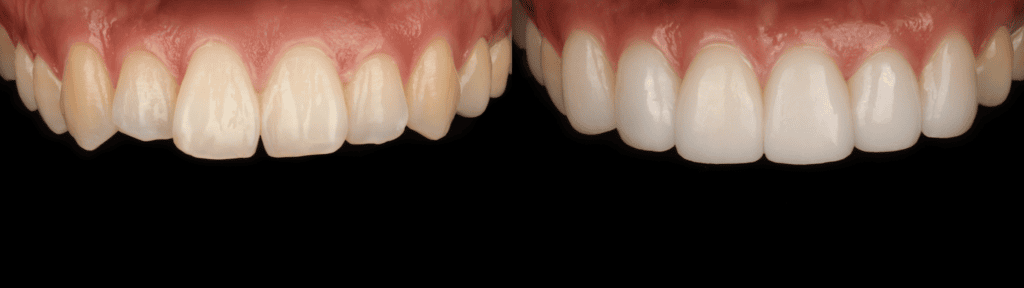
A no-prep veneer is a thin shell of porcelain made in a lab. It is bonded onto the enamel without shaving the tooth.
Composite bonding is a tooth-colored resin. The dentist sculpts it directly on your tooth and hardens it with a light.
So the real difference is the material and where it is shaped. Porcelain is fired outside the mouth. Resin is built up inside it, layer by layer.
That single difference drives almost everything else: how long the result lasts, how it resists stains, and how it looks up close.
No Prep Veneers vs Composite Bonding, Pictured Simply
Think of repairing a scratched wooden table. Composite bonding is like filling the scratch with wax and polishing it by hand. It is quick and flexible, but the wax wears and dulls over time.
A no-prep veneer is like laying a thin, finished panel over the surface. It takes more preparation to make, but the finish stays glossy far longer.
No Prep Veneers vs Composite Bonding: How the Two Options Compare
Here is a side-by-side view of the points patients ask about most.
| No-prep veneers | Composite bonding | |
|---|---|---|
| Material | Porcelain made in a lab | Resin sculpted in the mouth |
| Tooth shaving | None | None or very little |
| Stain resistance | High; the glazed surface resists coffee and tea | Lower; resin picks up stains over time |
| Surface gloss | Stays glossy for years | Needs repolishing |
| Repairs | Replaced as a unit if damaged | Easy to patch in the chair |
| Reversibility | Enamel stays intact under the shell | Enamel stays intact under the resin |
| Upfront cost | Higher | Lower |
Neither option is better in every row. The right choice depends on which rows matter most for your teeth and habits.
No Prep Veneers vs Composite Bonding: When Veneers Make More Sense

No-prep veneers suit people who want a long-lasting change in color and shape. They are especially useful when several front teeth are involved.
1. You want a whiter shade that stays put
Porcelain holds its color. If you drink coffee, tea or red wine often, the glazed surface keeps its brightness much longer than resin.
2. Your teeth are small or have gaps
Small teeth and gaps leave room to add material. A thin porcelain shell can lengthen or widen them without any shaving.
3. You are treating four to eight teeth together
When several teeth change at once, matching shape and shade matters. Lab-made shells are easier to keep consistent across a whole smile.
For a deeper look at who qualifies and how to avoid over-grinding, see our guide to no-prep veneers in Korea.
No Prep Veneers vs Composite Bonding: When Bonding Makes More Sense
Bonding is a good fit for small, local fixes. It is also useful when you are not ready to commit to porcelain.
1. You need one small repair
A chipped corner or a tiny gap between two teeth can often be closed with resin in a single visit.
2. You want to test a new shape first
Some patients try bonding to see how a longer or wider tooth feels. Later, they move to porcelain once they are sure.
3. Your bite puts heavy force on the edges
If you grind your teeth, resin is easier to patch when it wears. In that case we also discuss a night guard before any cosmetic work.
If you are weighing porcelain against resin more broadly, our porcelain vs composite veneers guide covers lifespan and cost in more detail.
No Prep Veneers vs Composite Bonding: Questions That Decide the Choice

In consultation, we usually settle the decision with a few practical questions.
① How long do you want the result to last?
If you want a result you rarely think about, porcelain is usually the better fit. If you expect to adjust things later, bonding keeps options open.
② How many teeth are involved?
One or two small fixes lean toward bonding. A full smile change leans toward veneers.
③ Is your bite comfortable?
Adding thickness to the front of a tooth needs room against the lower teeth. We check this for both options.
④ Are your teeth well aligned?
If teeth are badly crowded, neither option should force them straight. In that case we suggest orthodontic treatment first, because it keeps more of your natural tooth.
⑤ What does your budget look like over time?
Bonding costs less at first, but repolishing and repairs add up. Porcelain costs more upfront and usually needs less upkeep.
No Prep Veneers vs Composite Bonding: What Drives the Cost?
Thin porcelain is harder to make, not easier. Cost depends on the ceramic grade, the share of hand finishing, the number of teeth and the quality of the bonding system.
Bonding matters more than most people expect. We use the Ivoclar adhesive system, which sits at the highest price tier among dental adhesives.
It is biocompatible, which supports your health, and it resists discoloration at the edges. If you want to know what your own case allows, a photo consultation is the fastest starting point.
Not sure where your case fits? Send two photos — front and smiling — on WhatsApp. We will tell you what is possible before you book any flight.
Planning Blanche No-Prep Veneers in Seoul
Blanche Dental Clinic runs its own in-house lab, Blanche Lab, near Nonhyeon Station. Our technicians can adjust shade and thickness on site, which helps keep no-prep shells thin.
We ask for photographs in advance. That lets us discuss shade, shape and whether no-prep suits you before you book a flight.
For the full one-day program — technology, pricing, and booking — see our One-Day Veneers page.
Our pricing is the same for Korean and international patients. The clinic is in Nonhyeon, Gangnam, about an hour from Incheon Airport by airport bus or taxi.
A common pattern we see
A frequent case is someone with slightly small front teeth and faint stains. Bonding would fix the size, but the stains tend to return, so porcelain is usually the longer-term answer.
Another common case is one chipped tooth in an otherwise healthy smile. Here, bonding is often the simpler and kinder choice.
Frequently Asked Questions
Q. Do either of these options damage my teeth?
Neither requires shaving in suitable cases, so the enamel underneath stays intact. The key is a careful bite check before treatment.
Q. Can I switch from bonding to no-prep veneers later?
Yes. Because bonding leaves the enamel in place, it can be removed and replaced with porcelain when you are ready.
Q. No prep veneers vs composite bonding: which looks more natural?
Both can look natural when well designed. Porcelain keeps its translucency and gloss longer, while resin may dull without polishing.
Side Effects and Individual Differences
Temporary sensitivity or a foreign-body feeling can occur after treatment. Results vary with each person’s teeth, so the method should be decided after an examination and consultation.
I am a dentist trained at Seoul National University, and I have spent ten years working mainly with veneers. My principle is simple: keep as much of your own tooth as the result allows.
At our clinic this approach has a name: Blanche no-prep veneers. The goal is always to keep your enamel where it belongs.
If you would like to know whether no-prep veneers or bonding suits you, we can start from photographs.
What happens at your first consultation
1. We listen first — what bothers you and what you hope for. 2. We walk you through your scan results and every option.
3. You get itemized costs and timing, and you can decide later, even after you fly home. At Blanche, we explain everything at least four times, by principle.
Consultation — Blanche Dental Clinic is located between Nonhyeon and Sinnonhyeon stations in Gangnam, Seoul. You can reach us on WhatsApp for a photo consultation, and our pricing page lists treatment fees in advance.