

Veneers for small teeth are one of the most common requests we see, and also one of the most misread. Many people arrive convinced their teeth are too small, when the measurements say something else.
Sometimes the teeth really are undersized. Sometimes they are a normal size, but the gum sits too low, or the edges have worn down over the years.
Those are different problems. They also have different answers, and picking the wrong one is how people end up with a smile that looks bulky rather than balanced.
This guide walks through what a dentist actually measures, and what each finding means for your plan.
A note from Dr. Kim — Many people who land on this page share one quiet worry: what if I damage healthy teeth for nothing? It is the first question I ask myself with every patient.
Blanche began with that question: why harm a natural tooth worth more than any restoration? That is why our signature Blanche no-prep veneers follow one rule — minimal intervention, maximum beauty.
Veneers for Small Teeth: What “Small” Usually Turns Out to Be
There are four separate findings that all get described the same way by patients. Only one of them is true microdontia.
1. Genuinely undersized teeth
The clearest case is the peg lateral. These are the two teeth beside your front teeth, and they can come in narrow and cone-shaped.
This is genetic and fairly common. It usually affects one or both laterals rather than the whole smile.
2. Teeth that are short because the gum covers them
Here the tooth is a normal length. Part of it is simply still hidden under gum tissue.
This is why some people look like they have small teeth and a lot of gum at the same time. Adding porcelain to a tooth that is already the right length only makes it look thicker.
3. Teeth that were worn down
Grinding, acidic drinks and years of function all shorten the biting edges. The tooth loses height from the top rather than never having had it.
You can often spot this yourself. Worn front teeth tend to have flat, straight edges instead of the soft curve a young tooth has.
4. Teeth that look small because of the space around them
A normal tooth in a wide arch reads as small. The gaps beside it do the work, not the tooth itself.
This is the group where veneers change the most with the least material. You are filling space rather than building bulk.
Veneers for Small Teeth: The Four Measurements Behind the Decision
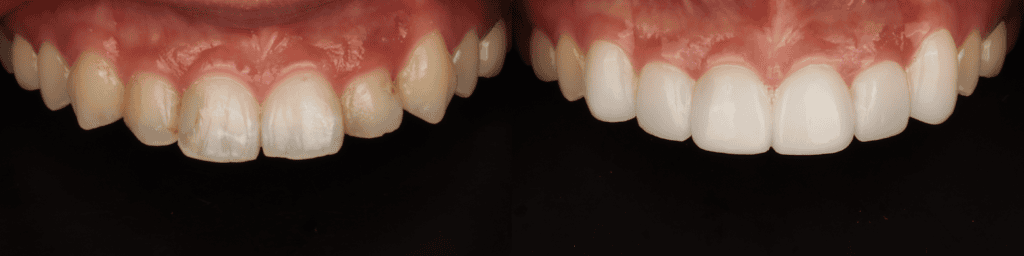
Instead of guessing, we take four readings before we design anything.
| What we measure | Typical reference | What it tells us |
|---|---|---|
| Width-to-length ratio of the central incisor | Roughly 75–85% | Whether the tooth is truly narrow, or short |
| Gum line height across the six front teeth | Even, with laterals slightly lower | Whether gum contouring should come first |
| Incisal edge position when lips are at rest | A small amount of tooth visible | How much length can safely be added |
| Total space available in the arch | Measured against tooth widths | Whether we are closing gaps or widening teeth |
These four readings interact. A tooth can be narrow and short at the same time, and each finding changes what the veneer has to do.
The ratio matters most. If your central incisor is 8.5mm wide and 9mm long, it is not a small tooth at all — it is a short one, and the fix starts at the gum.
Veneers for Small Teeth: Why the Plan Changes With Each Finding
If the teeth are genuinely narrow, veneers work well. Porcelain adds width where nature did not, and the result sits inside normal proportions.
If the gum is covering the tooth, we usually recontour the gum line first. Only then do we decide whether a veneer is needed at all.
If the edges are worn, we look for the cause before rebuilding. Adding length to a tooth that is being ground down every night is a short-term answer.
If the problem is spacing, the question becomes how many teeth to include. Widening only two teeth in a wide arch tends to look obvious, so the count usually needs to be even across the smile. Our guide on how many veneers you actually need covers that in detail.
The Trade-off Nobody Mentions

Making a tooth wider closes the gap on both sides. That is the point, but it also moves the contact point between the teeth.
Move it too far toward the gum and a small dark triangle appears underneath. Move it too far toward the edge and the teeth start to look fused.
Length has a limit too. Past a certain point, added length affects speech and the way the lower teeth meet the uppers.
This is why we would rather remove very little enamel and accept a modest change than force a dramatic one. If your case allows a minimal-prep approach, our page on no-prep veneers and who qualifies explains the limits honestly.
For badly broken-down teeth, a veneer may not be the right restoration at all. The comparison in veneers versus crowns shows where the line sits.
Planning Veneers for Small Teeth as a Visiting Patient
Small-tooth cases need proportion decisions made before you fly. Photographs taken straight-on and from the side let us take the first measurements in advance.
Our fees are the same for local and international patients. There is no visitor surcharge at any stage.
We also run our own in-house lab, Blanche Lab, at our Nonhyeon Station clinic. Shade and shape adjustments happen with the technician in the building rather than by courier.
Same-day treatment is priced higher than the conventional route, because the diagnosis, design, fabrication and fitting are all compressed into one day with the dentist and lab team working on your case together. For the full one-day program — technology, pricing, and booking — see our One-Day Veneers page.
Not sure where your case fits? Send two photos — front and smiling — on WhatsApp. We will tell you what is possible before you book any flight.
Veneers for Small Teeth: What Actually Drives the Cost
Material grade is only one line in the estimate. The bonding system matters just as much, and it is rarely discussed.
We use the Ivoclar adhesive system. It sits at the top of the price range for bonding materials, chosen for its biocompatibility and its resistance to discoloration at the margin.
That margin is the line you will see in five years. On small teeth it sits close to the gum, where it stays wet, so colour stability there is not a minor detail.
Veneers for Small Teeth: Frequently Asked Questions

Can veneers fix peg lateral teeth?
Yes, peg laterals are one of the most predictable veneer cases. The tooth is narrow rather than damaged, so porcelain mainly adds width and shape.
Will making my teeth bigger look fake?
It depends on the ratio, not the size. A tooth built within normal width-to-length proportions reads as natural, while one widened past that range starts to look artificial.
Do I need braces first if my teeth are small and spaced?
Not always. If the total space is close to what the teeth need, veneers alone can close it — but if the gaps are wide, alignment first usually protects more of your own tooth structure.
Side Effects and Individual Variation
Every dental treatment carries risks and varies between individuals. After veneer treatment you may notice temporary sensitivity, gum irritation, or a changed bite sensation.
Outcomes and longevity depend on the condition of your teeth and gums, your bite forces, and your daily habits. This article is general information and does not replace a personal diagnosis, so please decide with your treating dentist after an examination.
A Closing Thought
In the clinic, the most useful thing I do in a small-tooth consultation is measure before I discuss porcelain. More than once, the answer has been that the teeth were never small at all.
If you are not sure which of the four findings applies to you, send us a straight-on photo of your smile and we will tell you what we see.
Written by Kim Tae-hyung, DDS (Director, Blanche Dental Clinic · Seoul National University-trained dentist)
What happens at your first consultation
1. We listen first — what bothers you and what you hope for. 2. We walk you through your scan results and every option.
3. You get itemized costs and timing, and you can decide later, even after you fly home. At Blanche, we explain everything at least four times, by principle.
Consultation — Blanche Dental is located between Nonhyeon and Sinnonhyeon stations in Gangnam, Seoul. For a consultation in English, message us on WhatsApp with your photos, and see our pricing page for current fees.