
Most smile plans start and stop at the top row. Veneers on bottom teeth come up later, usually when someone looks at a photo and notices the lower arch no longer matches.
It is a fair question, and the honest answer is that lower teeth follow different rules. They are smaller, they take the brunt of the bite, and in many faces they barely show at all.
This guide covers who benefits, the four measurements we use to decide, and what to plan for if you are travelling for treatment.
A note from Dr. Kim — Many people who land on this page share one quiet worry: what if I damage healthy teeth for nothing? It is the first question I ask myself with every patient.
Blanche began with that question: why harm a natural tooth worth more than any restoration? That is why our signature Blanche no-prep veneers follow one rule — minimal intervention, maximum beauty.
Why Veneers on Bottom Teeth Are a Different Problem
Lower front teeth are roughly half the width of upper ones. Some are only a few millimetres across.
That size difference matters because a veneer needs a minimum thickness to look like enamel rather than a flat chip. On a narrow tooth, that same thickness takes up a larger share of the surface.
There is a second difference. In most bites, the upper front teeth close over the lower ones.
So the edges of your lower incisors sit under direct pressure every time you bite. A porcelain edge placed there is loaded in a way an upper veneer never is.
The Door Frame Comparison
Think of a door that scrapes the floor. You can plane the bottom of the door, and it will swing freely for a while.
But if the frame itself has shifted, the door will scrape again. Lower veneers work the same way: shaping the surface helps, while the forces closing on it stay exactly as they were.
That is why a bite check comes before any discussion of shade or shape.
Veneers on Bottom Teeth: Four Measurements That Decide
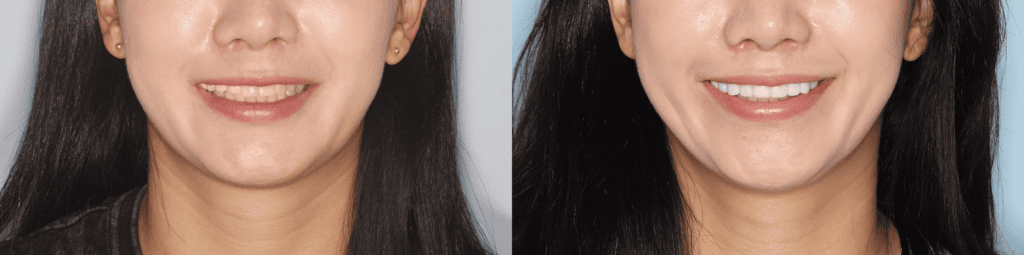
1. How much of the lower arch actually shows
Stand in front of a mirror and say a long “eee”. Then check a recent photo of yourself laughing.
Many people show almost no lower teeth when smiling, and quite a lot when speaking. If your lower arch never appears in either, veneers there are cosmetic spending with very little visible return.
2. Enamel thickness on a small tooth
We measure the remaining enamel before anything else. Bonding holds best to enamel, not to the softer dentine underneath.
On a small lower incisor that has already been worn down or filled, there may not be enough surface left. In that situation, adding a veneer means removing healthy structure you cannot get back.
3. Bite depth and edge clearance
If your upper teeth cover the lower ones deeply, the lower edges have no clearance. Porcelain placed into that space chips sooner.
Some deep bites can still be treated by adjusting the upper edges first. Others need the bite opened, which is an orthodontic step rather than a restorative one.
4. Crowding and root position
Lower crowding is extremely common, partly because the arch is short and partly because it worsens with age.
Porcelain changes the shape of a tooth. It does not move the root. When a lower incisor is rotated behind its neighbour, covering the front of it means grinding one side far more than the other.
| What we measure | Suitable for veneers | Better handled another way |
|---|---|---|
| Visible display | Lower teeth show when speaking or laughing | Lower arch never appears |
| Remaining enamel | Even, intact enamel across the face | Heavily worn or previously filled |
| Bite clearance | Edges have room to close | Deep bite with no clearance |
| Root position | Mild rotation, roots upright | Crowding with tipped roots |
| Wear pattern | Stable, no active grinding | Active grinding untreated |
Reading the table honestly is the point. Two of these five lines send people to orthodontics first, and that recommendation is about preserving tooth structure, not about the format of the treatment.
Matching the Top Row You Already Have

If you already have upper veneers, the lower teeth will eventually look darker by comparison. Natural enamel keeps ageing while porcelain does not.
This is the most common reason patients ask about the lower arch a few years after their first treatment. It is a genuine mismatch, not imagination.
You have two routes. Whitening the lower teeth may close the gap if the difference is small, since natural enamel responds to whitening and porcelain does not.
If the difference is larger, matching porcelain to porcelain gives a more predictable result. We check this with the existing shade in daylight before committing.
For how counting works across both arches, see our guide on how many veneers you need. If enamel loss is your main concern, what veneers actually do to your enamel covers it in detail.
Not sure where your case fits? Send two photos — front and smiling — on WhatsApp. We will tell you what is possible before you book any flight.
Planning Veneers on Bottom Teeth as a Visiting Patient
Lower veneers rarely stand alone. They are usually decided during the same consultation as the upper arch, which means your plan can change once we measure the bite.
Send clear photos before you travel. A straight-on smile, a relaxed speaking photo, and a shot of your lower arch from below tell us most of what we need.
Our lab is inside the clinic, so shade adjustments happen the same day rather than waiting on an outside technician. For the full one-day programme — technology, pricing, and booking — see our One-Day Veneers page.
Two practical notes. Pricing is the same for international and Korean patients, so there is no visitor surcharge to ask about.
And cost differences between clinics are not only about the ceramic grade. We use the Ivoclar bonding system, which sits at the top of the price range for adhesives and holds its colour at the margin far better over time — and on lower teeth, the margin is exactly where wear shows first.
Related reading: what veneers actually cost per tooth in Seoul.
Veneers on Bottom Teeth: Frequently Asked Questions
Can you get veneers on bottom teeth only?
Yes, and it is a reasonable request when the upper arch is already satisfactory. The main check is whether the lower teeth show enough to justify the treatment, and whether the bite leaves clearance at the edges.
Do lower veneers chip more often than upper ones?
They are under more direct load, so edge design matters more. With adequate clearance and a treated grinding habit, longevity is comparable. Without those two things, lower veneers do fail sooner.
How many lower veneers do people usually get?
Four or six is typical, matching the teeth that appear when you speak. Going wider than your visible display adds cost without adding visible change.
Side Effects and Individual Variation
Temporary sensitivity to cold is common in the first weeks. Gum tissue near new margins may be tender while it settles.
Outcomes and longevity vary with remaining enamel, bite forces, grinding habits, and daily care. The information above is general. Any actual recommendation follows an examination and a clinical consultation.
A Closing Note
After ten years of treating front teeth, the pattern I see most often with the lower arch is this: people ask for veneers there when what has really changed is the contrast with the upper row.
Blanche Dental is near Nonhyeon Station in Gangnam, with our own laboratory inside the clinic. Consultations in English are available, and we are glad to tell you when the lower arch does not need treating at all.
Send a photo and we will start from what your smile actually shows.
Dr. Kim Tae-hyung (Director, Blanche Dental Clinic · Seoul National University trained dentist)
What happens at your first consultation
1. We listen first — what bothers you and what you hope for. 2. We walk you through your scan results and every option.
3. You get itemized costs and timing, and you can decide later, even after you fly home. At Blanche, we explain everything at least four times, by principle.
Consultation — Blanche Dental is located between Nonhyeon and Sinnonhyeon stations in Gangnam, Seoul. For a consultation in English, message us on WhatsApp with your photos, and see our pricing page for current fees.