

Veneers for teeth grinding are usually discussed as a yes-or-no question. Most people want one answer: can I get them, or not?
That framing hides the useful part. Grinding is not one habit. It is at least three different force patterns, and each one changes the plan in a different way.
This article covers what bruxism actually breaks, how to tell which pattern you have, and what has to be handled before porcelain goes on.
A note from Dr. Kim — Many people who land on this page share one quiet worry: what if I damage healthy teeth for nothing? It is the first question I ask myself with every patient.
Blanche began with that question: why harm a natural tooth worth more than any restoration? That is why our signature Blanche no-prep veneers follow one rule — minimal intervention, maximum beauty.
Veneers for Teeth Grinding: What Actually Breaks First
Modern porcelain is hard. In a grinding case, the part that fails first is usually not the middle of the veneer.
It is the edge. The biting edge takes the impact, and thin ceramic at a sharp margin is where a chip starts.
The second failure point is the bond line. Repeated sideways force does not snap porcelain. It works the veneer loose over months, like a tile that gets nudged every night.
The Tile Analogy
Think of a tile glued to a wall. Press straight into it and nothing happens.
Now push it sideways, a thousand times. The tile is fine. The glue is what gives up.
That is why grinding cases are a bonding problem before they are a material problem.
Veneers for Teeth Grinding: The Three Force Patterns
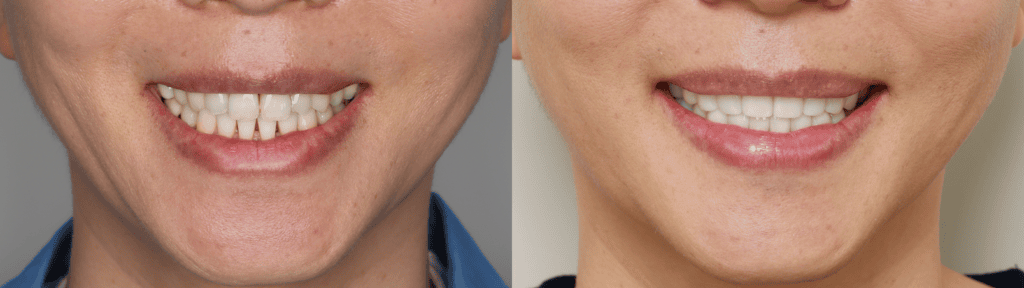
Ask your dentist which of these describes you. The answer changes the design.
| Pattern | How you notice it | What it changes in the plan |
|---|---|---|
| Night clenching (vertical) | Sore jaw on waking, flat wear on back teeth | Mostly manageable. Back teeth absorb the load, front edges less so. |
| Night grinding (lateral) | Shiny flat facets on canines, partner hears it | Highest risk to front veneers. Canine guidance must be rebuilt first. |
| Daytime bracing | You catch yourself clenched at a screen | Habit-driven. Often improves with awareness and does not need hardware. |
| Edge-to-edge bite | Front teeth meet tip to tip, not overlapping | Structural, not habitual. Needs bite planning, sometimes alignment first. |
The fourth row is the one people miss. If your front teeth already meet edge to edge, force lands on the exact spot a veneer is thinnest.
That is not a grinding habit. That is where your teeth sit, and no material choice fixes it on its own.
Planning Veneers for Teeth Grinding: Four Things That Come First
In practice, four items get settled before any preparation begins.
1. Where the canines make contact
Canines are meant to separate the back teeth when your jaw slides sideways. When they are worn flat, that separation is gone.
Force then spreads to the front teeth. Restoring canine shape is often the single most protective step in a grinding case.
2. How much enamel is left
Years of grinding thin the enamel at the edges. Bonding to dentin is weaker than bonding to enamel.
This is measured, not guessed. It also affects how conservative the preparation can be.
3. Edge thickness and shape
A long, thin, square edge looks striking in photos. In a grinder, it is the first thing to chip.
Rounding the edge slightly and keeping it a touch shorter is a real trade-off. You give up a little drama and gain durability.
4. The bonding system
In a grinding case the adhesive is doing more work than usual, every night. We use the Ivoclar bonding system, which sits at the higher end of adhesive pricing.
It is chosen for biocompatibility and colour stability at the margin. That margin is exactly where lateral force and saliva both concentrate.
This is worth knowing when you compare quotes. Two estimates naming the same ceramic can still differ, because the adhesive and the number of teeth are not the same.
Veneers for Teeth Grinding: Can You Wear a Night Guard?

Yes, and in a grinding case it is usually part of the plan rather than an optional extra.
One detail matters for travellers. A guard made before treatment will not fit afterwards, because the shape of your teeth has changed.
The guard has to be made after the veneers are seated. If you are flying in for treatment, build that into the schedule rather than leaving it for later.
If You Are Coming From Abroad
Grinding cases need the bite checked while you are still in the chair. Photographs sent in advance help us flag the pattern before you book.
Our fees are the same for local and international patients, so the quote you receive is the quote everyone receives. For the full one-day programme — technology, pricing, and booking — see our One-Day Veneers page.
We also run our own in-house lab in Nonhyeon, which means shape adjustments happen in the same building rather than between appointments.
Not sure where your case fits? Send two photos — front and smiling — on WhatsApp. We will tell you what is possible before you book any flight.
Veneers for Teeth Grinding: What This Means in Practice
Grinding is common. In clinic, a large share of people asking about front-tooth work show some wear facets, and most of them are treatable.
What separates a good outcome from a repeat visit is rarely the ceramic brand. It is whether the sideways force was mapped and redirected before anything was bonded.
If you want the wider picture on longevity, our guide on how long veneers last covers material and habit factors together. For what holds them in place, see what actually keeps veneers on, and our aftercare guide covers the first weeks.
Veneers for Teeth Grinding: Frequently Asked Questions
Can I get veneers if I grind my teeth?
In most cases yes, provided the bite is assessed first. The plan usually includes rebuilding canine guidance, adjusting edge thickness, and a night guard made after the veneers are fitted.
Will grinding crack porcelain veneers?
Cracks through the body of a veneer are uncommon. Chipped edges and loosened bond lines are the more typical outcomes, which is why edge shape and adhesive choice matter so much.
Should I stop grinding before getting veneers?
Reducing daytime clenching helps, but night grinding is not usually something you can simply stop. The realistic goal is to redirect the force through bite design and a guard, not to eliminate the habit.
Side Effects and Individual Variation
All dental treatment carries possible side effects and varies between individuals. Sensitivity, gum irritation, margin staining and chipping can occur, and outcomes depend on remaining enamel, gum condition, bite forces and daily care.
This article is general information and does not replace an individual examination. Actual treatment and its scope depend on your clinical findings.
A Closing Note
When someone tells me they grind, I do not start with materials. I start by watching the jaw move sideways.
That single movement tells me where the force goes, and where it must not go. Everything after that is design work built around the answer.
If you are unsure which pattern applies to you, send photographs before you travel and we will tell you what the bite needs before anything is bonded.
Dr. Kim Tae-hyung (Director, Blanche Dental Clinic · Seoul National University trained dentist)
What happens at your first consultation
1. We listen first — what bothers you and what you hope for. 2. We walk you through your scan results and every option.
3. You get itemized costs and timing, and you can decide later, even after you fly home. At Blanche, we explain everything at least four times, by principle.
Consultation — Blanche Dental is located between Nonhyeon and Sinnonhyeon stations in Gangnam, Seoul. For a consultation in English, message us on WhatsApp with your photos, and see our pricing page for current fees.